


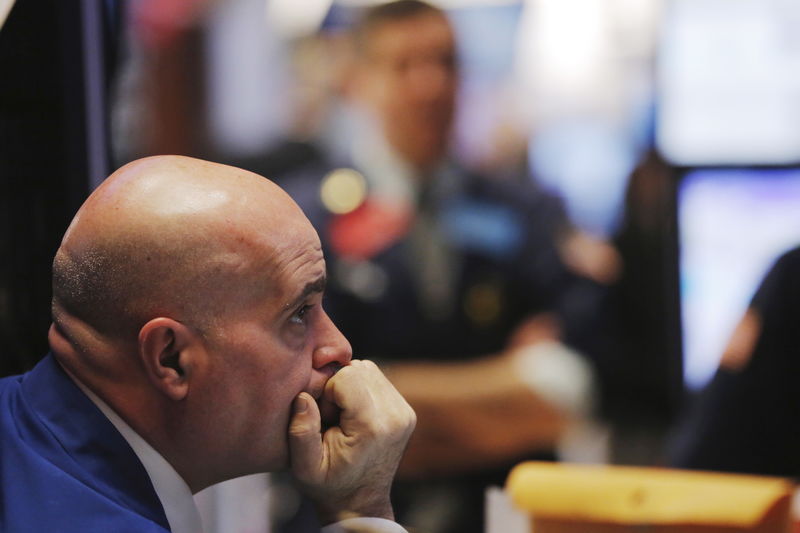
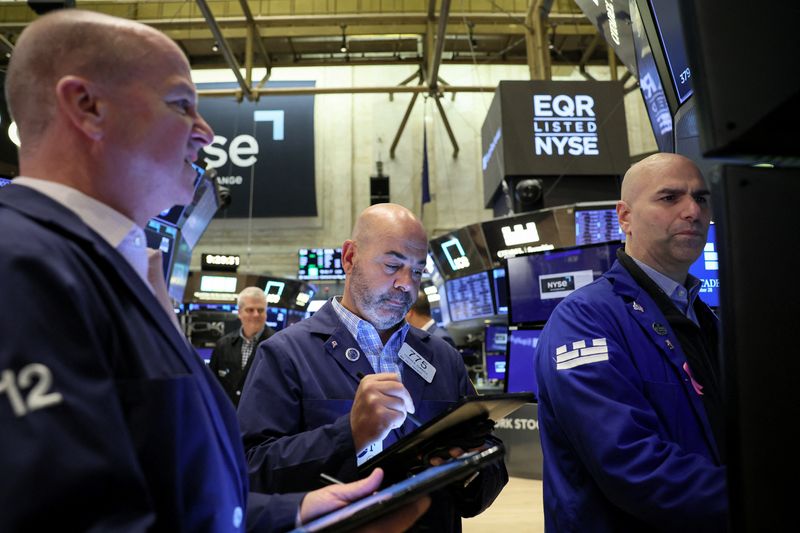
© Reuters. FILE PHOTO:Traders work on the floor of the New York Stock Exchange (NYSE) in New York City, U.S., September 28, 2023. REUTERS/Brendan McDermid/File Photo
By Ankika Biswas and Shashwat Chauhan
(Reuters) -Wall Street’s main indexes dropped on Thursday as recent data pointed to still-tight labor market conditions, while U.S. Treasury yields remained at elevated levels.
Even as longer-dated Treasury yields eased from 16-year highs on Wednesday, investors remain concerned that the elevated levels may continue to pressure equities.
Worries about U.S. government spending and its ballooning budget deficit have added to uncertainty around the interest rates trajectory, contributing to a steep selloff that have caused a rout in Treasury prices.
“The problem behind high yields isn’t so much the data as it is the Fed,” said Thierry Wizman, Macquarie’s global FX and interest rates strategist.
“Beyond a further decline in inflation, another catalyst for yields to come down would be some combination of a U.S. recession and/or a financial ‘accident’ that threatens to produce a recession.”
The Labor Department’s report showed the number of Americans filing new claims for unemployment benefits rose moderately last week, while layoffs declined in September, pointing to still-resilient labor market conditions.
Following a slew of mixed jobs reports so far this week, focus will be on the more comprehensive September non-farm payrolls data on Friday.
“For now, labor market conditions are still easing without a significant rise in unemployment. Fed officials will need to see further softening in the September employment report and beyond to prevent them from raising rates one more time this year,” Michael Pearce, lead U.S. economist at Oxford Economics, said.
At 11:58 a.m. ET, the was down 174.42 points, or 0.53%, at 32,955.13, the was down 29.31 points, or 0.69%, at 4,234.44, and the was down 103.98 points, or 0.79%, at 13,132.04.
Materials, consumer staples and consumer discretionary stocks fell more than 1% each, leading a broader decline in the major S&P 500 sectors.
Following the recent weakness, investors will monitor if the S&P 500 falls below its 200-day moving average, currently at around 4,206.
Traders put the chance of interest rates remaining unchanged in November and December at around 78% and 66%, respectively, according to CME’s FedWatch tool.
Federal Reserve policymakers including Minneapolis’ Neel Kashkari, Richmond’s Thomas Barkin and Vice Chair for Supervision Michael Barr are set to speak during the day.
San Francisco Fed President Mary Daly on Thursday said U.S. monetary policy is “well into” restrictive territory and there has been a lot of progress toward 2% inflation, but that progress “isn’t victory”.
Among stocks, Clorox (NYSE:) dropped 8.1% as the cleaning products maker said it expects to post a first-quarter loss.
Rivian (NASDAQ:) Automotive fell 20.4% after the EV maker said it plans to sell convertible green bonds worth $1.5 billion and forecast quarterly revenue to rise in line with estimates.
VinFast (NASDAQ:) gained 2.7% after the Vietnamese EV maker reported third-quarter revenue that more than doubled.
Lamb Weston Holdings (NYSE:) jumped 9.2% after the frozen potato products supplier raised its annual profit and sales forecast.
Declining issues outnumbered advancers for a 2.01-to-1 ratio on the NYSE and a 1.47-to-1 ratio on the Nasdaq.
The S&P index recorded three new 52-week highs and 31 new lows, while the Nasdaq recorded 18 new highs and 235 new lows.

